
Is Buying a Smaller Home Worth It in the Bay Area?

For many Bay Area homeowners, downsizing sounds appealing.
A smaller home can mean less maintenance, fewer rooms to clean, lower utility costs, and potentially more money available for other priorities. But in the Bay Area, buying a smaller home doesn't automatically mean spending less.
A smaller condominium in a desirable neighborhood may cost more per square foot than a larger home elsewhere. HOA dues can add significant monthly expenses. And transaction costs associated with selling your current home and purchasing another property can affect how much financial benefit you actually receive.
So, is buying a smaller home worth it in the Bay Area?
For many homeowners, it can be—but the answer depends on your equity, purchase price, ongoing expenses, lifestyle goals, and the type of property you're considering.
What Does "Downsizing" Really Mean?
Downsizing isn't simply moving from a 2,500-square-foot home to a 1,500-square-foot home.
It can mean reducing:
- Square footage
- Bedrooms
- Outdoor space
- Maintenance
- Storage
- Commute time
- Home-related expenses
- Daily responsibilities
In some cases, the biggest benefit isn't the smaller house itself.
It's the lifestyle that comes with it.
Why Bay Area Homeowners Consider Downsizing
Homeowners often consider buying smaller homes because their current property no longer fits their needs.
For example:
- Children have moved out.
- The home feels too large.
- Maintaining the yard has become burdensome.
- Certain rooms are rarely used.
- They want to be closer to family.
- They want a more walkable lifestyle.
- They want to reduce housing expenses.
- They want to access some of their home equity.
For longtime homeowners, downsizing can be a way to turn an oversized property into a home that better matches their current lifestyle.
The Financial Benefits of Buying Smaller
A smaller home can potentially reduce some ongoing costs.
Depending on the property, you may spend less on:
- Utilities
- Landscaping
- Repairs
- Routine maintenance
- Furnishings
- Property upkeep
However, don't assume that every smaller home will cost less.
The total cost of ownership matters more than square footage.
A Smaller Home Can Still Be Expensive
Bay Area real estate is heavily influenced by location.
A 1,200-square-foot condominium in a highly desirable, walkable neighborhood may cost more than a much larger home in another area.
That's why you should compare:
Purchase price + monthly ownership costs + maintenance + HOA + taxes + insurance
rather than simply comparing square footage.
HOA Dues Can Change the Equation
If you're considering a condominium or townhome, HOA dues deserve particular attention.
An HOA may cover certain exterior and common-area maintenance, which can reduce your personal responsibilities.
But monthly dues can also be substantial.
Before buying, review:
- Monthly HOA dues
- Reserve funds
- Special assessments
- Insurance
- Maintenance responsibilities
- Recent HOA financial documents
- Rental restrictions
- Community rules
A smaller home with high HOA costs may not reduce your monthly expenses as much as expected.
Consider Your Current Home's Equity
For longtime Bay Area homeowners, equity can be one of the biggest advantages of downsizing.
Suppose your current home has appreciated significantly over the years.
Selling it and purchasing a less expensive property could potentially allow you to unlock some of that equity.
That money could potentially be used for:
- Cash reserves
- Investments
- Retirement goals
- Travel
- A future purchase
- Paying down debt
- Other financial priorities
The amount you actually retain depends on your sale price, mortgage balance, selling costs, purchase costs, taxes, and other factors.
Don't Confuse Equity With Cash
This distinction is important.
If your home is worth $1.5 million but you still have a $500,000 mortgage, you don't have $1.5 million available to spend.
You have approximately $1 million in gross equity before transaction costs and other adjustments.
Your net proceeds after selling expenses are what matter when determining how much capital you can put toward your next home.
Calculate Your Net Proceeds Before Shopping
Before looking seriously at smaller properties, estimate:
Expected sale price
minus:
- Mortgage payoff
- Selling costs
- Repairs
- Preparation expenses
- Other transaction costs
= Estimated net proceeds
This gives you a more realistic picture of your purchasing power.
It can also help you determine whether downsizing will actually free up meaningful capital.
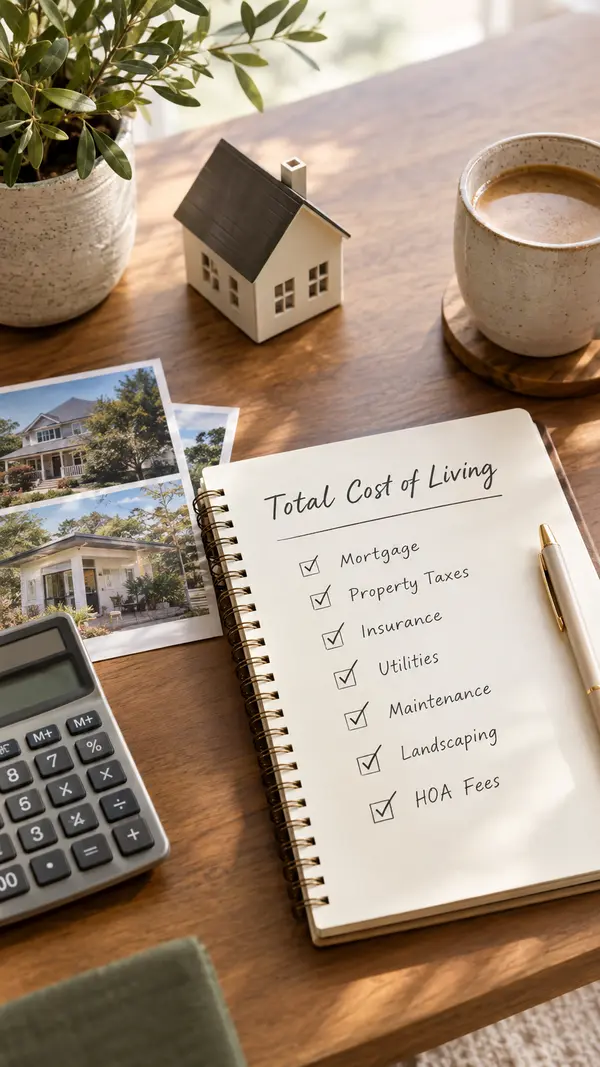
Compare Your Current Monthly Expenses
Write down what your current home costs you each month.
Include:
- Mortgage
- Property taxes
- Insurance
- Utilities
- Landscaping
- Maintenance
- HOA, if applicable
- Other recurring expenses
Then estimate the same expenses for the smaller property.
The difference may be smaller—or larger—than you expect.
Consider Property Taxes Carefully
Property taxes can be an important part of the Bay Area downsizing equation.
Don't assume that buying a less expensive home automatically means your property tax situation will simply transfer to the new property.
California property tax rules can be complex, and certain homeowners may qualify for specific provisions depending on their circumstances.
Before making a decision based on expected property taxes, consult the appropriate county assessor or a qualified tax professional about your specific situation.
What About Selling Costs?
Downsizing involves transaction costs.
When selling your current home, you may have expenses associated with:
- Real estate commissions
- Transfer taxes
- Preparation
- Repairs
- Staging
- Photography
- Moving
Then, when buying your next home, you may have additional costs such as:
- Closing costs
- Inspections
- Loan costs
- Escrow-related expenses
- Moving expenses
- Immediate repairs or improvements
These costs can significantly affect the financial benefit of downsizing.
The Lifestyle Benefits May Be Just as Important
Financial savings aren't the only reason to downsize.
A smaller home may give you more time.
Think about the hours you currently spend:
- Cleaning
- Maintaining the yard
- Organizing storage
- Repairing the property
- Managing unused rooms
If you reduce those responsibilities, you may have more time for:
- Travel
- Family
- Hobbies
- Exercise
- Friends
- Community activities
For some homeowners, that time is more valuable than the financial savings.
A Smaller Home Can Mean a More Convenient Lifestyle
Many downsizers aren't simply looking for less space.
They're looking for more convenience.
You might choose a smaller home that is:
- Closer to restaurants
- Near grocery stores
- Near BART
- Near family
- Close to parks
- In a walkable neighborhood
- Near healthcare
In that situation, you may be trading square footage for location.
For many buyers, that's a worthwhile trade.
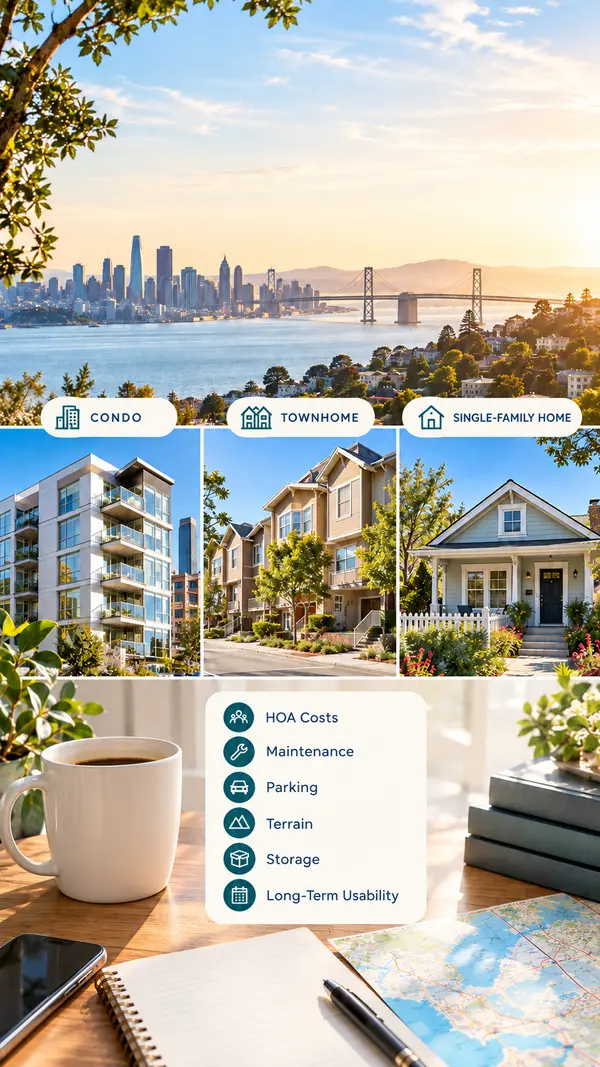
Consider a Condominium
A condominium may be a logical choice if your priority is reducing exterior maintenance.
Potential advantages include:
- Less yard maintenance
- Shared amenities
- Common-area maintenance
- Convenient locations
- Potentially lower overall maintenance responsibilities
But remember that you are exchanging some individual control for shared ownership responsibilities.
Review the HOA carefully before making an offer.
Consider a Townhome
Townhomes can provide another middle-ground option.
You may get:
- More space than many condos
- A private entrance
- Outdoor space
- Less exterior maintenance
- A residential neighborhood setting
But if the property has multiple floors, consider whether the layout will continue to work for you long term.
Consider a Smaller Single-Family Home
If you don't want an HOA or shared walls, a smaller detached home may be the better fit.
The challenge is finding a property that is actually lower maintenance.
A 1,500-square-foot home with a large yard may require more upkeep than a 1,300-square-foot condominium.
Look beyond the interior square footage.
Think About Your Next 5–10 Years
One of the biggest downsizing mistakes is buying only for today's needs.
Ask:
Will this home still work for me five or ten years from now?
Consider:
- Stairs
- Entry access
- Bathroom layout
- Bedroom location
- Parking
- Transportation
- Maintenance
- Healthcare access
- Proximity to family
A home that works well today but becomes difficult to manage later may not be the best downsizing decision.
Don't Automatically Buy the Smallest Home
Downsizing doesn't mean minimizing everything.
You still need space for the things you enjoy.
Consider whether you need:
- A guest room
- Home office
- Hobby space
- Storage
- Outdoor space
- Parking
The goal isn't to buy the smallest property possible.
The goal is to buy the right-sized property.
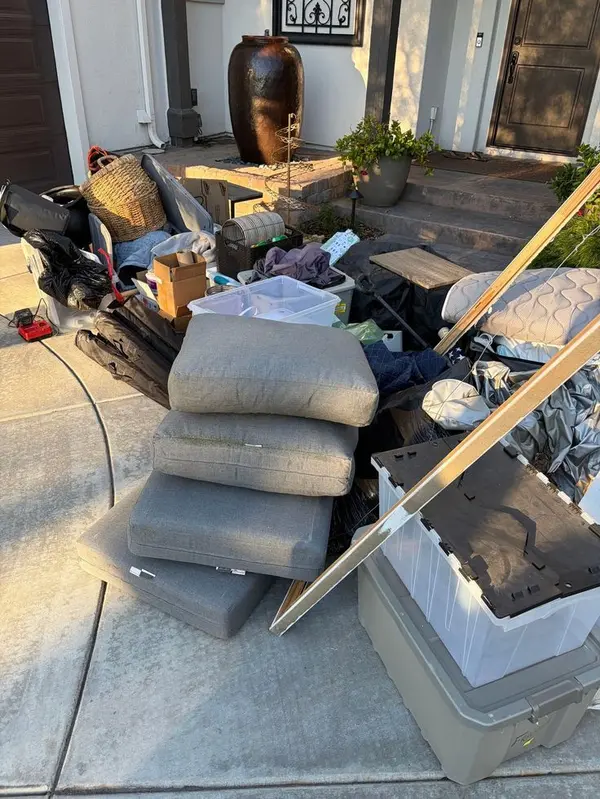
Think About Your Furniture
Your furniture can help determine how much space you actually need.
Before choosing a smaller property, decide what you're keeping.
Measure:
- Sofa
- Dining table
- Bed
- Dressers
- Cabinets
- Outdoor furniture
This can prevent the common mistake of buying a home that technically fits your budget but doesn't comfortably fit your lifestyle or belongings.
What If You Buy in a More Expensive Neighborhood?
Sometimes downsizing means spending nearly as much—or even more—for a smaller home in a better location.
For example, you might trade a large suburban property for a smaller home closer to:
- BART
- Restaurants
- Shopping
- Parks
- Family
- Employment centers
Financially, that may not maximize your equity.
But from a lifestyle perspective, it may be exactly what you want.
This is why "worth it" isn't purely a financial calculation.
Evaluate Price Per Square Foot Carefully
Price per square foot can be useful when comparing properties, but it shouldn't be the only metric.
A smaller property in a desirable location can command a higher price per square foot because buyers are paying for:
- Location
- Convenience
- Transit
- Neighborhood quality
- Scarcity
- Amenities
Use price per square foot as one data point—not the entire valuation strategy.
What About Investment Potential?
If you're selling a longtime home and buying another property, you may also want to consider the investment characteristics of the new property.
Look at:
- Neighborhood demand
- Property condition
- Future resale appeal
- Housing scarcity
- Transit access
- Buyer demand
- HOA financial health
A home can serve two purposes:
Your residence and a long-term asset.
Ideally, the property works well for both.
Should You Keep Your Current Home Instead?
Downsizing doesn't automatically require selling.
Some homeowners consider keeping their existing property as a rental while purchasing a smaller home.
That can provide potential rental income and continued exposure to Bay Area real estate.
But it also means taking on:
- Landlord responsibilities
- Maintenance
- Vacancy risk
- Property management
- Continued carrying costs
Compare the potential rental economics with what you could accomplish by selling and accessing your equity.
When Buying Smaller May Be Worth It
Buying a smaller Bay Area home may make sense if:
- Your current home is much larger than you need.
- You have substantial equity.
- You want less maintenance.
- You want to reduce your monthly expenses.
- You want a more convenient location.
- You want to unlock some equity.
- You're comfortable giving up space.
- Your next home fits your long-term lifestyle.
When It May Not Be Worth It
Downsizing may not provide the benefits you expect if:
- The new property is nearly as expensive.
- HOA dues are high.
- Transaction costs consume much of your equity.
- You still need substantial space.
- You purchase a property requiring significant repairs.
- The new location doesn't improve your lifestyle.
- You're giving up features you actually use.
Sometimes staying in your current home is the better financial decision.
A Simple Downsizing Comparison
Before making a decision, compare your current home with the property you're considering.
|
Factor |
Current Home |
Smaller Home |
|
Purchase/Market Value |
— |
— |
|
Mortgage |
— |
— |
|
Property Taxes |
— |
— |
|
HOA |
— |
— |
|
Insurance |
— |
— |
|
Maintenance |
— |
— |
|
Utilities |
— |
— |
|
Square Footage |
— |
— |
|
Bedrooms |
— |
— |
|
Outdoor Space |
— |
— |
|
Walkability |
— |
— |
|
Transportation |
— |
— |
|
Estimated Net Equity |
— |
— |
This can help you see whether you're actually improving your financial and lifestyle position.
The Most Important Question
Instead of asking:
"Can I afford a smaller home?"
Ask:
"What do I gain by moving into a smaller home?"
Maybe the answer is:
- Less maintenance
- More cash
- Better location
- More free time
- Lower expenses
- Greater convenience
- A home that better fits your current life
If the benefits are meaningful, downsizing may be worth considering.
The Bay Area Perspective
For Bay Area homeowners, downsizing requires more than simply comparing two purchase prices.
The real estate market is highly neighborhood-specific. A smaller property in Berkeley, El Cerrito, Oakland, Albany, or another desirable East Bay location may carry a very different price and lifestyle profile than a larger property elsewhere.
This is where understanding property valuation and local market conditions becomes especially important.
The question isn't just what your current home is worth.
It's what you can realistically achieve by selling it and reallocating that equity into a property that better fits your needs.
The Bottom Line
Is buying a smaller home worth it in the Bay Area?
It can be.
But the best downsizing decision isn't necessarily the one that gives you the lowest purchase price.
It's the one that creates the best combination of:
Financial flexibility + lower maintenance + better lifestyle + appropriate long-term value.
Before making a move, calculate your expected net proceeds, compare the total cost of ownership, evaluate the neighborhood, and think carefully about how you want to live for the next five to ten years.
A smaller home isn't automatically a better home.
The right-sized home in the right location can be.
About Parisa Samimi
With 25 years of experience in residential and investment real estate, Parisa is recognized as a leading top producer across the San Francisco Bay Area. Her background as a real estate appraiser gives her a rare valuation advantage, allowing clients to make informed, strategic decisions in every market condition.
Parisa's work is defined by precision, integrity, and an unwavering attention to detail. She brings a hands-on, solutions-driven approach to every transaction, ensuring that both buyers and sellers feel guided, protected, and empowered throughout the process.
Her passion for the business is evident in the energy and care she brings to each client relationship, qualities that consistently set her apart. Actively representing both buyers and sellers, Parisa is known for her deep market knowledge, strong negotiation skills, and commitment to achieving exceptional results.
Whether preparing a home for the market, navigating complex investment opportunities, or helping clients find the perfect property, she delivers a thoughtful and elevated experience at every step.
Wondering Whether Downsizing Makes Financial Sense for You?
Before putting your home on the market or shopping for something smaller, it helps to understand what your current home is worth, how much equity you could potentially unlock, and what your next home would actually cost.
Contact Parisa Samimi for a personalized Bay Area downsizing consultation.
With 25 years of experience and a background in real estate appraisal, Parisa can help you evaluate your current property's value, compare potential replacement properties, and develop a strategy based on both the numbers and the lifestyle you want.
Your next home should be the right size, in the right location, at the right value for your next chapter.
Categories
Recent Posts





GET MORE INFORMATION

Parisa Samimi
Founder & Real Estate Broker License ID: 01858122
Founder & Real Estate Broker License ID: 01858122